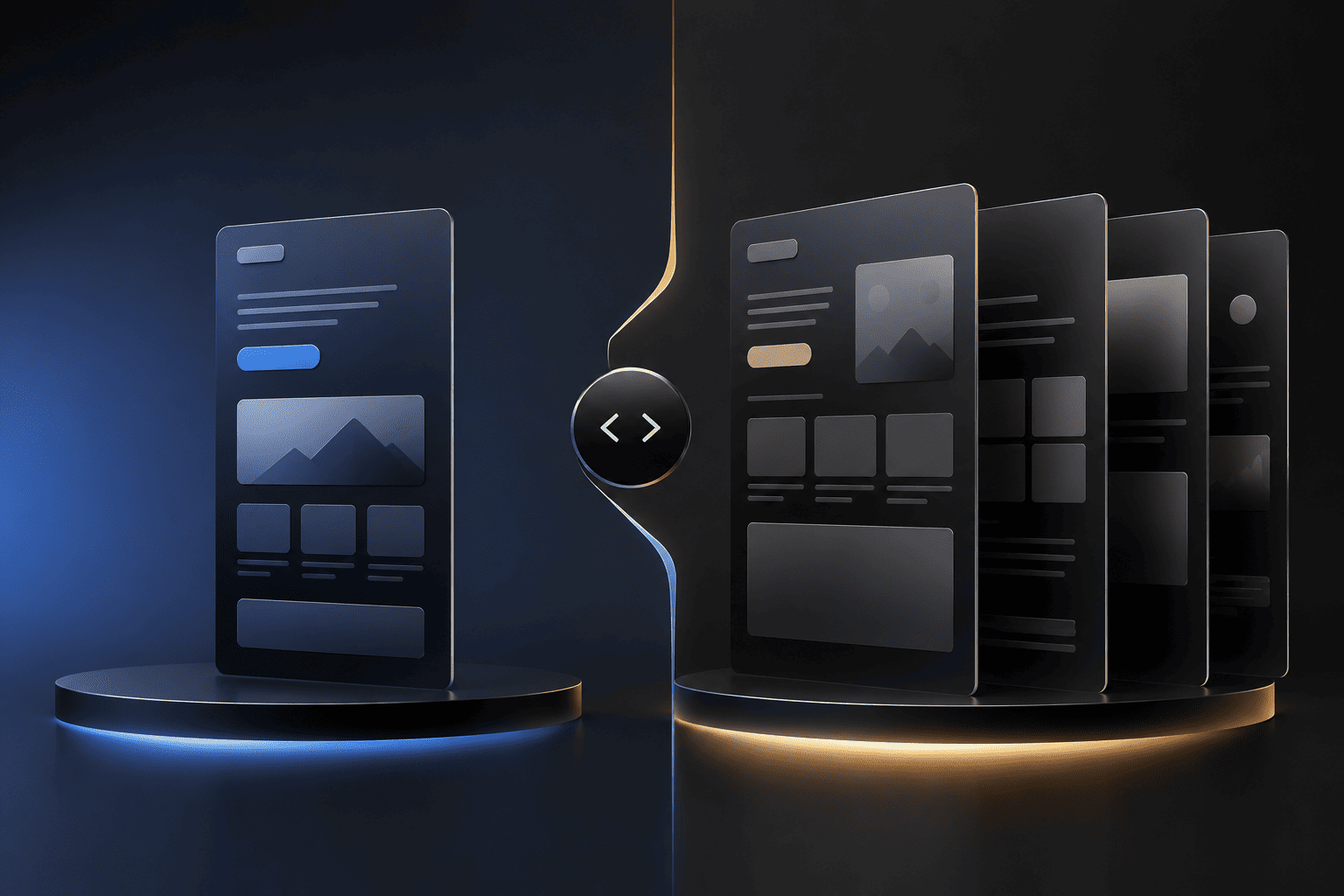
Stages of turnkey website development: from idea to launch
Turnkey website development is often perceived as a single process in which “design and then build the site”. In practice, it's more complicated. If you skip at least one key step, the site may look neat but not work as a customer acquisition tool. A good website does not start with design. It begins with an understanding of the task, audience and logic on which the user will make a decision. Let’s analyze in order what a normal turnkey website development process looks like and why each stage affects the result.

- Topics
- Development
- Date
- Reading time
- 5 min
1. Immersion in task and analysis
At the first stage, it is important not just to collect wishes, but to understand business. What services or products are offered, who the target audience is, how customers come in now and what tasks the site should solve.
Without this stage, development turns into guesswork. As a result, the site may not get into the audience or in business expectations.
Usually, this includes basic analytics, studying competitors and shaping the overall direction of the project.
2. Site structure and logic
After analysis, the structure of the site is formed. This is one of the most important stages that is often underestimated.
Pages, blocks, sequence of information submission and logic of user movement are defined. In fact, this is the framework of the future site.
If the structure is built correctly, the user understands where he is, what he is offered and what action to do next. If not, even good design doesn’t save the day.
At this stage, the foundations of SEO are also laid, since the structure directly affects the further promotion of the site.
3. Elaboration of meanings and texts
The next step is what the site will say.
Texts are not written at the end when the design is ready. They form the basis on which the visual is then superimposed.
Here, it is important to reveal the benefits, remove objections, explain value and guide the user to a targeted action. Without this, the site remains just a set of blocks.
Well-designed texts can significantly boost website conversions without additional advertising costs.
4. Prototyping
After the structure and texts, a prototype is created. This is a simplified version of the site without the final design, where you can already see the location of blocks, texts and logic of interaction.
This stage allows you to check in advance how convenient the site is perceived, and make changes before starting the design.
According to statistics, projects that use prototyping require 30-40% less edits at the design and development stage.
5. Website design
Only after all the previous stages does the design begin.
The task of design is not just to “make beautiful”, but to strengthen meanings, place accents and help the user make a decision faster.
Good design works in conjunction with structure and text, not separately from them. It does not overload, distract or interfere with the perception of information.
6. Development and layout
At this stage, the design is transferred to the work site. Depending on the task, it can be a development on Tilda, Bitrix or creating a self-written solution.
Here it is important not only to visually repeat the layout, but also to correctly implement adaptability, download speed, forms and basic technical optimization.
Mistakes at this stage can cause the site to perform poorly on mobile or load slowly, which directly affects conversion and SEO of the site.
7. Integration and customization
After development, all the necessary services are connected. These can be lead forms, CRM, analytics, payment systems, notifications.
Also at this stage, basic analytics tools such as counters and events are configured so that the performance of the site can be tracked in the future.
Without these settings, it is impossible to understand how the site works and what results it brings.
8. Testing
Before launching, the site must be checked.
The operation of all forms, the correctness of the display on different devices, the loading speed, the logic of transitions and the absence of technical errors are checked.
This stage is often tried to reduce, but it allows you to avoid problems after launch.
9. Launching a website
After testing, the site is transferred to the main domain and becomes available to users.
It is important to understand that the launch is not the final point. This is the beginning of a website in a real environment.
10. Refinement and development
After the launch, a stage begins that many people ignore.
User behavior is analyzed, leads are tracked, the effectiveness of the structure and texts is checked. On the basis of this data, changes are made.
It is at this stage that the site begins “to be modified for reality” and gradually strengthens the result.
Which is the end
The development of a turnkey site is not one stage and not only design. It is a process where each step affects the final result.
If you remove the analytics, the structure will be weak.
If you skip the text, the site will not convince.
If the technical part is not worked out, speed and SEO will suffer.
That’s why a good website is assembled as a system, not as a collection of individual elements.
Conclusion
Stages of turnkey website development are built from meaning to implementation. First, logic and content are formed, then the visual and technical part are connected.
This approach allows you to create not just a website, but a tool that works for business and brings leads.
When the process is built correctly, the site does not require constant alterations and becomes the basis for further growth and promotion.